Archaeologists working at an ancient settlement in central Turkey have discovered a Christian amulet dating back about 1,500 years, containing a delicate gold sheet that may bear a biblical inscription.
The artifact was uncovered at Türkmen Karahöyük in Turkey’s Konya province, according to the state-run Anadolu Agency. The excavation has brought together an international team of roughly 60 researchers representing 13 countries.
Experts believe the amulet dates to the fourth or fifth century A.D., when Christianity was spreading across the Roman Empire.
The object includes a copper casing enclosing a gold sheet measuring only 0.1 millimeters in thickness. Researchers said a passage from the Bible was “most likely” written on the sheet, although the exact text has not yet been identified.
Michele Rüzgar Massa, co-director of the excavation, told Anadolu Agency that similar finds are rare.
“As far as we know, one similar example was found in Germany,” Massa said, adding that the amulet may have been worn by a child as a form of spiritual protection. “In other words, you can think of it like an evil-eye charm,” Massa added.
The discovery is part of a broader excavation effort at Türkmen Karahöyük, where archaeologists continue to uncover evidence from civilizations that occupied the site over thousands of years.
Researchers have also unearthed a stone seal carrying a hieroglyphic Luwian inscription dated to around 1500 to 1400 B.C. The Luwians were an ancient Anatolian people active during the Bronze and Iron Ages.
Two copper seals and a clay seal impression were also recovered from the site.
Hüseyin Erpehlivan, deputy director of the excavation, said Türkmen Karahöyük is particularly important because of its location in central Anatolia.
“Konya is located right in the center of Anatolia, in a region where cultures intersect,” Erpehlivan said. “Türkmen Karahöyük is not an excavation focused on a single period.”
“We are investigating a multilayered settlement extending from the Late Hellenistic period through the Iron Age and Bronze Age and into even earlier periods,” he added.
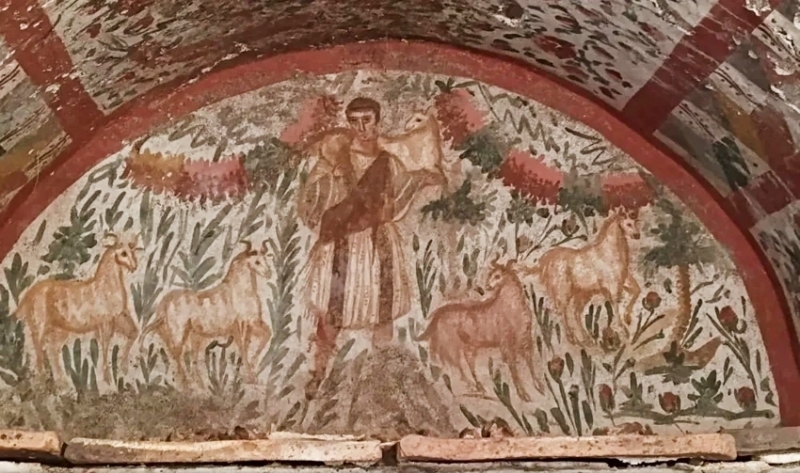
The amulet is the latest in a string of archaeological discoveries with biblical connections reported in Turkey in recent months, including a 2,500-year-old marble statue unearthed at ancient Sardis and a third-century fresco in Iznik portraying Jesus as the Good Shepherd.