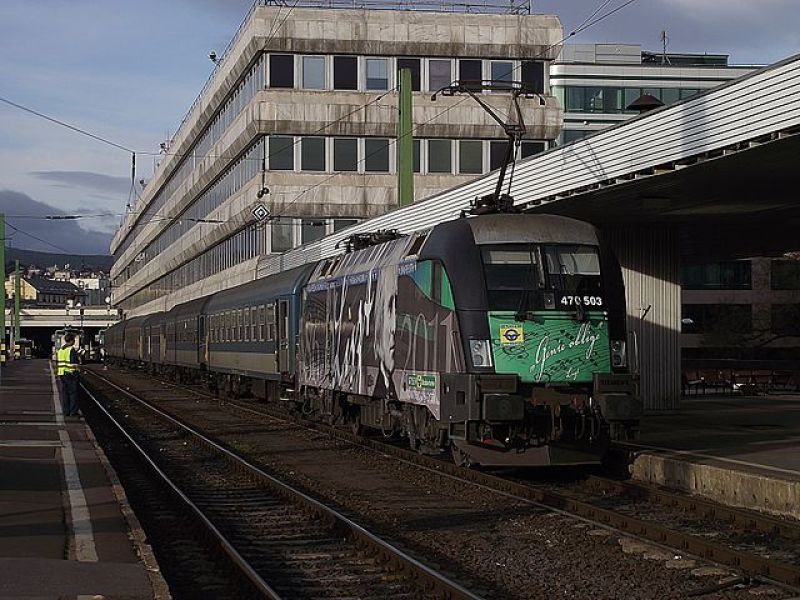
Hundreds of migrants wanting to travel to Germany protested at the Budapest train station on Tuesday, when they were stopped from boarding trains to western Europe by the Hungarian police, according to reports.
Earlier this week, about 3,600 refugees reached Austria via trains from Hungary.
In response to growing concerns over unrestrained travel of asylum seekers from Middle East and northern Africa, to Schengen countries via the Balkans and Hungary, government authorities in Budapest shut-off the city's railway station.
The movement of refugees across Europe is one of the biggest since WWII.
Zoltan Kovacs, a spokesman for Hungarian government said that the refugees are being kept back in Hungary in accordance with the EU law - 'Dublin rules,' that requires migrants to first apply for asylum in the first EU country they enter. The European nations on the south -- Hungary, Italy, and Greece -- are usually the first EU countries the refugees step in. However, these countries do not yet have the system in place to process thousands of applications in a short amount of time.
The efficacy of implementation of 'Dublin rules' is limited due to the open borders between the 28 EU members.
However, last month Germany stepped in to assist the cause of Syrian refugees by deciding not to send the asylum seekers back to their first EU-entry country to process their applications.
Germany will not send the war-fleeing Syrians back to Hungary, but 'Dublin rules' still remain in place, and the EU governments are working to assure that proper procedures are carried out before the refugees head out to their favored destinations.
"Germany has not suspended Dublin. Dublin rules are still valid and we expect European member states to stick to them."
EU members are trying to arrange for a more equal distribution of refugees across the union to cope with the arrival of unprecedented volumes of migrants.
German Chancellor Angela Merkel said in a news conference: "For those refugees who are being persecuted or have fled war, there should be a fair distribution in Europe based on the economic strength, productivity and size of each country."
The EU members are expected to draw out a refugee-sharing plan in the coming week, for an equitable settlement of the asylum seekers, and deportation of fraudulent aliens, according to Reuters.
Up until now, Germany has received the highest influx of refugees, with many having traversed the EU bloc illegally in the absence of border controls.
Meanwhile, the migrants who had arrived in Vienna earlier this week were told to stay back at the station for screening.
"We are still in the process of verifying how many of them are actually asylum-seekers," Patrick Maierhofer, spokesperson from Austrian police told AFP.
The refugees wanted to travel to Germany, but had to spend their night at the Westbahnhof train station in Austria.
Last week, a group of 71 migrants was found dead in a truck on a highway in Austria. Seven suspects including four Bulgarians and one Afgan national have been arrested in connection with the case.
On Wednesday, body of a three-year-old Syrian child was found on a beach in Turkey, who was part of a group attempting to sail to Kos island in Greece.