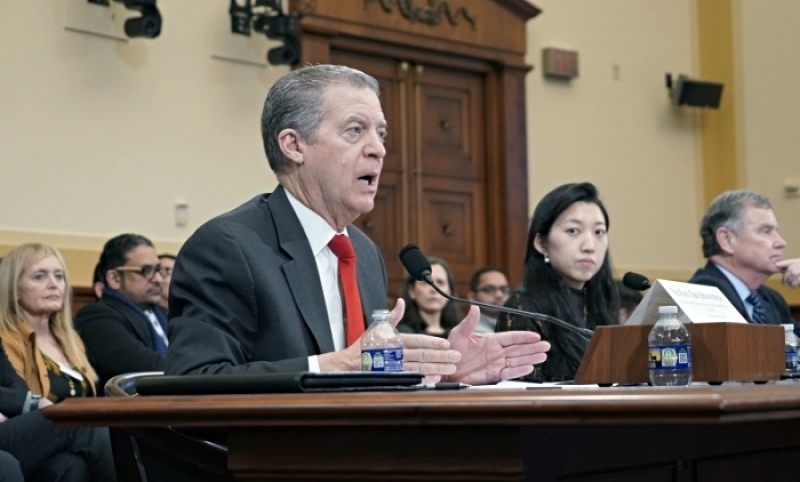
At a joint Feb. 4 hearing of the House Foreign Affairs Africa and Western Hemisphere subcommittees in Washington, former U.S. Ambassador-at-Large for International Religious Freedom Sam Brownback warned that a growing alliance of authoritarian states now views religious freedom as a threat to their control.
“We are seeing something unprecedented really right now in the world, and I’ve been in this work and this space for some period of time,” Brownback told lawmakers. “This alliance of communist, authoritarian, totalitarian regimes will literally stop at nothing to control people of faith. They see people of faith as a threat.”
Brownback said China stands at the center of this alliance, noting that the Chinese Communist Party spends billions of dollars annually to suppress religious expression at home while exporting advanced surveillance technologies to other repressive regimes abroad.
“The community of faith has become the target of this dark alliance that we’re facing off against, and China is the puppet master behind all of it,” Brownback said. “And we should be deeply concerned about those issues, because that equipment then we’re going to face in multiple sets of countries, and they’re going to use that to maintain the dictatorships, the authoritarians that are standing against us that want to remove the United States leadership and the Western leadership.”
Brownback said a forthcoming book he co-authored on China’s global campaign against religion, scheduled for release in May, documents the spread of surveillance technologies into dozens of countries.
“When the book had been written, it was in 80 countries, the various surveillance technologies and various iterations of it,” he said.
He also alleged that Nigeria has sought or received assistance from countries including China, Russia, Turkey, and Saudi Arabia, arguing that these partnerships complicate efforts to protect religious freedom.
According to Brownback, promoting religious liberty remains the most effective way for democratic nations to counter authoritarian regimes and address broader security threats.
“This is unprecedented – it is really unprecedented, and it’s a dark hour,” he said. “The U.S. and other freedom-loving nations must rise to this challenge that we’re facing today.”
Committee member Joaquin Castro, D-Texas, emphasized during the hearing that religious freedom is a universal principle that transcends political parties, faith traditions, and geographic regions.
Castro criticized the current administration for failing to nominate an Ambassador-at-Large for International Religious Freedom, a position mandated by law, instead appointing a principal adviser to lead the office.
The Trump administration, Castro said, is more than a year overdue in releasing its annual International Religious Freedom reports and, aside from Nigeria, has not designated additional Countries of Particular Concern as required under U.S. law.
Rep. Sara Jacobs, D-Calif., echoed those concerns, pointing out that the 2024 International Religious Freedom Report was due last May and that preparations for the 2025 report are already behind schedule.
Jacobs also warned that funding cuts have weakened international efforts to defend persecuted religious communities.
“As part of its foreign assistance review, the administration cut millions of dollars worth of foreign assistance related to international religious freedom,” she said. “For example, Freedom House has reported that the administration terminated its Asia religious and ethnic freedom program that was supporting 4,000 members of religious minority groups facing discrimination and persecution, including Christian minority groups, Uyghurs and others.”
The Trump administration also made cuts to a Non-Governmental Organization that left 400 cases undertaken by religious freedom defenders in limbo, she said.
“This means that this organization could no longer provide life-saving assistance to Afghan women who bravely ran for public office following the U.S. withdrawal, or Iranian journalists who were reporting on human rights violations by Iran’s regime, or Nicaraguan journalists who have been arrested and forced into exile by the regime, and many, many more,” Jacobs said.


