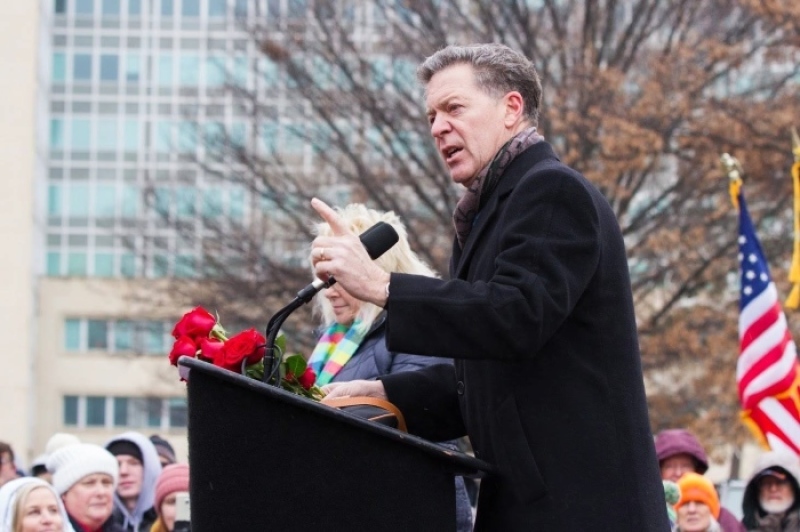
Former U.S. Ambassador-at-Large for International Religious Freedom Sam Brownback called on the Trump administration to intervene for Morse H. Tan, his former diplomatic colleague who has been barred from leaving South Korea for months.
"I was shocked, I really was," Brownback told The Christian Post about the exit ban against Tan, who served with him in the U.S. State Department as the U.S. ambassador-at-large for global criminal justice during President Donald Trump's first term.
Tan has been prohibited since June from leaving South Korea and is slated to face his first trial hearing in the country Friday for allegedly defaming its president on American soil last year. He was swept up into the reopened criminal investigation against him when he traveled to South Korea in late May to observe local elections amid allegations of irregularities and Chinese interference.
"Here's a former U.S. diplomat, a respected legal scholar and professor who's being arrested and persecuted in a democracy," continued Brownback, the former governor of Kansas who was the U.S. ambassador-at-large for international religious freedom from 2018 to 2021. "If he were traveling to North Korea or Russia, I wouldn't be surprised at all. But he's not. It's South Korea, and so I was really stunned when I first heard about it."
Tan, whose successive exit bans have reportedly been extended until at least November, was charged without detention in July with criminally defaming South Korean President Lee Jae Myung during a June 2025 event about Korean election integrity at the National Press Club in Washington, D.C.
A clip went viral on social media at the time of Tan noting at the event that there have been rumors and reports that Lee was involved in "gang-raping and murdering a young lady" when he was a teenager, and that he was consequently unable to attend junior high and high school after being put in juvenile detention.
During an interview with CP last month, Tan remained skeptical of the Korean courts and fact-checks that have dismissed the allegations he repeated against Lee, though he framed his situation as a broader violation of his rights as a U.S. citizen amid the erosion of rights in South Korea.
Morse H. Tan: Three successive travel bans have been imposed on me because I have been leading the counterrevolutionary movement against the communizing coup d’état and the subsequent purge currently happening in South Korea. @MorseHTanpic.twitter.com/7474fTeNcR
— Bannon’s WarRoom (@Bannons_WarRoom) August 6, 2026
Tan has been an outspoken critic of the current South Korean government, which he called "a rising dictatorship." He alleged to CP that the key American ally is increasingly subject to "massive infiltration by Chinese Communist Party and North Korean spies, operatives and agents flooding the country."
A devout Christian, Tan also said he believes he is potentially being targeted because of his faith.
Brownback echoed Tan's concern regarding the political trajectory of South Korea, whose former President Yoon Suk Yeol was sentenced to life imprisonment earlier this year for declaring martial law in December 2024. Before he was impeached and removed from office in 2025, Yoon claimed that his declaration was an attempt to counter the threat from North Korean communists and root out pro-North, anti-state elements.
South Korea has also recently imprisoned multiple religious leaders, including Pastor Son Hyun-bo, who met with Trump at the White House last month after spending months in detainment. Son, who leads the conservative Christian movement "Save Korea" and has organized rallies against Yoon's impeachment, faced allegations of illegal electioneering during the Korean presidential election.
"I'm really concerned about the trend right now, particularly toward religious leaders or religious-affiliated people," Brownback said of South Korea. "They've arrested a number of religious leaders, tried them and are certainly trying to intimidate religious figures and leaders. And I think it's a horrible trend line for that democracy. I don't understand it."
The former ambassador warned their tactics "will not play well for them long-term."
"It's against history. It's against what South Korea has [historically] done. And I understand maybe there's some near-term political benefits potentially, but this is not the way for a democracy to be trending, and particularly such a key ally of the United States in that region," he said.
Brownback also voiced concern about the potential influence on South Korea from the Chinese Communist Party (CCP), whose "tentacles" he claimed are extensive and reach even into the U.S.
"That's their playbook in democracies. They use our system against us. They use these open systems to infiltrate, to push us, to really try to ride the system," he said, adding that the CCP is "reaching here into this society, and I have no doubt that they're doing the same in South Korea, Japan and other other relatively open societies in the world."
Brownback acknowledged the delicate diplomatic situation the Trump administration faces in dealing with South Korea, but urged them to "push back" against its behavior, both toward Tan and more generally.
"We're at a tough time, and you play one game at a time, as the football saying is. And right now, the game is China. We need South Korea. We need Japan. We need these allies, and so I'm sure there's some hesitancy about pushing back too aggressively. But this is just not the way democracy should operate," he said, adding that India presents a similar problem as an important Asian ally that is persecuting Christians and other religious minorities.
"So I understand that, but still, on the long-term view of this, that's not healthy for an open democracy to really come after people of faith, when our foundational beliefs are religious freedom," he said.
Brownback warned that if religious liberty recedes in a society, its other liberties will follow.
"Religious freedom is that human right that can really pull the other ones along, or it also can be used to stymie the other ones. If you stymie religious freedom, it's going to hurt your freedom of speech, your freedom of assembly, your other basics," he said.
"This is the human right that can be the engine for pulling the others, but if that engine is stalled, it's going to hurt the others, too," he added.
Last month, multiple congressional Republicans sent a letter to South Korean Ambassador Kang Kyung-hwa condemning Tan's "remarkably unfair treatment" over statements he made in the U.S.
The U.S. State Department has previously suggested to CP that it is aware of Tan's situation, noting the Trump administration "has no higher priority than the safety and security of Americans" and "takes seriously any concerns that U.S. citizens are subject to exit bans without a fair and transparent process to resolve them."
"Due to privacy and other considerations, we have nothing further to share at this time," a spokesperson added.
This article was originally published by The Christian Post.