A 1,700-year-old inscription uncovered at a Roman-era temple in southeastern Turkey is giving archaeologists rare insight into how Christianity overtook one of the Roman Empire’s mystery religions.
Experts say the Aramaic text, carved near the entrance of an underground Mithras temple at Zerzevan Castle, records the closing of the sanctuary as Christianity gained influence in the late Roman Empire.
The inscription, which remained undeciphered after the temple was first discovered in 2017, appears together with a carved cross and indicates that the site was intentionally sealed after coming under Christian authority, according to Anatolian News.
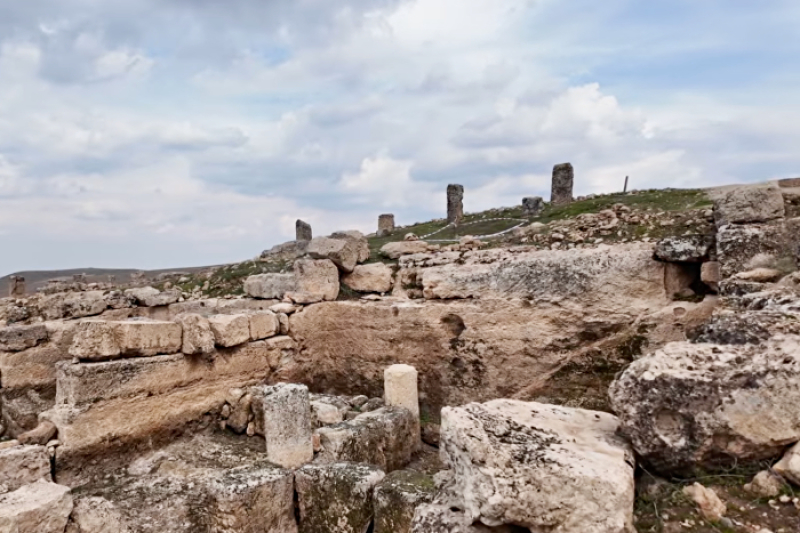
Zerzevan Castle, located near present-day Diyarbakır about 40 miles north of the Syrian border, once functioned as a Roman frontier fortress along the route between Amida and Dara. Excavations at the site have revealed military buildings, water systems and one of the Roman world’s best-preserved Mithraic sanctuaries beneath the fortress.
Mithraism was an all-male mystery religion devoted to Mithras, the Iranian god associated with the sun. The faith spread widely across the Roman Empire in the second and third centuries A.D., especially among soldiers and imperial officials, with rituals held in enclosed and often underground sanctuaries focused on light, cosmic order and initiation.
Roman soldiers are believed to have encountered Mithraism during military campaigns in regions corresponding to modern-day Iran and Iraq. But after Emperor Constantine embraced Christianity in the early fourth century, the religion quickly began to decline.
The newly interpreted inscription was examined by Mehmet Sait Toprak, who leads the Department of Syriac Language and Literature at Mardin Artuklu University. After comparing its language and letter forms with Syriac and Aramaic inscriptions from the second and third centuries A.D., Toprak dated the engraving to the third or fourth century.
Toprak said the text refers to the Holy Cross and describes God as one who “orders, reforms, and spreads love.” He said the inscription and the nearby cross likely served as a religious seal showing that the temple had been closed and stripped of its sacred function.
“This is an extremely important archaeological discovery,” Toprak told the state-run Anadolu Agency.
Excavation director Aytaç Coşkun said researchers in Turkey and abroad had studied the inscription since the temple’s discovery in 2017, but its meaning remained uncertain until the latest analysis. He said coins found earlier at the site pointed to the temple’s abandonment in the third or fourth century, while the inscription now offers direct evidence that it was closed during the Christian period.
The inscription refers to both Mithras and Jesus Christ, and archaeologists say the discovery offers unusually clear evidence of the religious transition that took place as Christianity spread and Mithraism came to be seen as a rival faith.