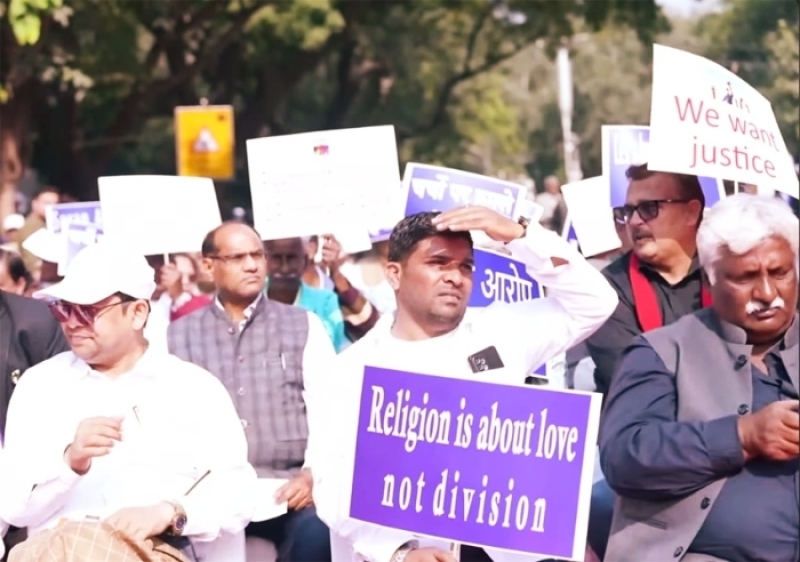
Around 2,000 Christians from across India gathered in New Delhi to protest what they describe as rising, sustained and systematic violence against their minority community.
Representing more than 200 denominations, civil society organizations and legal advocacy groups, the participants assembled on Nov. 29 under the banner of the National Christian Convention, reaffirming their commitment to the Indian Constitution and calling for unity, justice and hope.
According to the United Christian Forum (UCF), one of the event’s organizers, reported cases of violence against Christians have risen sharply—from 139 incidents in 2014 to 834 in 2024—amounting to nearly 5,000 documented cases over the past decade.
Speakers at the convention included Archbishop of Delhi Anil J. Couto, Dr. Michael Williams of UCF, Rev. Richard Howell of the Caleb Institute, activist Dr. John Dayal, Catholic priest and advocate Fr. Cedric Prakash, attorney Siju Thomas, Rev. Vijayesh Lal of the Evangelical Fellowship of India, and activist Arun Pannalal.
Presenters reiterated warnings about a 500% increase in reported attacks since 2014, noting that most incidents occur with little to no accountability.
Organizers announced plans to draft a national manifesto demanding protection for all Christians and ensuring justice for victims of persecution. The document will be submitted to the president, prime minister, chief justice of India and other key government leaders.
Many participants described a hostile climate characterized by fear and impunity, highlighting UCF data indicating that 93% of attacks go unpunished due to police inaction and threats of retaliation.
The denial of burial rights emerged as another major concern, particularly among tribal Christian communities who report being barred from cemeteries and in some cases forced to exhume the bodies of loved ones.
Tribal Christians also expressed alarm over campaigns seeking to strip them of their tribal status if they convert to Christianity or Islam—an action that could remove their eligibility for vital legal protections and affirmative action benefits.
The demonstration further condemned the misuse of anti-conversion laws in at least 12 states, which protesters argue are applied to criminalize peaceful prayer services and charitable activities.
Participants also criticized the use of the Foreign Contribution Regulation Act (FCRA) as a tool to suppress Christian institutions. The law governs the receipt of foreign funds by individuals, organizations and nonprofits, ostensibly to prevent activities harmful to national interests.
Between 2019 and 2023, more than 20,000 NGOs—including 1,626 Christian organizations—lost their FCRA registration. Groups such as World Vision India and the Evangelical Fellowship of India saw their licenses canceled after accusations of conducting “indirect conversions.”
Protesters noted that the 2020 FCRA amendment requires all NGO office bearers to file affidavits asserting they have never been prosecuted for religious conversions. Critics argue that this rule, combined with aggressive enforcement of anti-conversion laws, enables authorities to revoke registrations without due process.
Another significant issue raised at the rally was the continued exclusion of Dalit Christians from Scheduled Caste status under the 1950 Presidential Order, which currently applies only to Hindu, Sikh and Buddhist Dalits.
Speakers also condemned the use of “magic remedy” laws to criminalize Christian prayer practices. In Assam, activists noted that a 2024 law has been used to target evangelists under vague definitions of “healing fraud.”