Religious persecution against Christians and other faith communities has intensified worldwide in 2026, while international efforts to defend religious freedom have weakened, according to the newly released yearbooks “Religious Freedom 2026” and “Persecution and Discrimination against Christians 2026.”
The reports were presented at a news conference in Berlin on Tuesday (Nov. 3), where editors concluded that conditions for religious believers have either deteriorated or remained severely restricted compared with previous years.
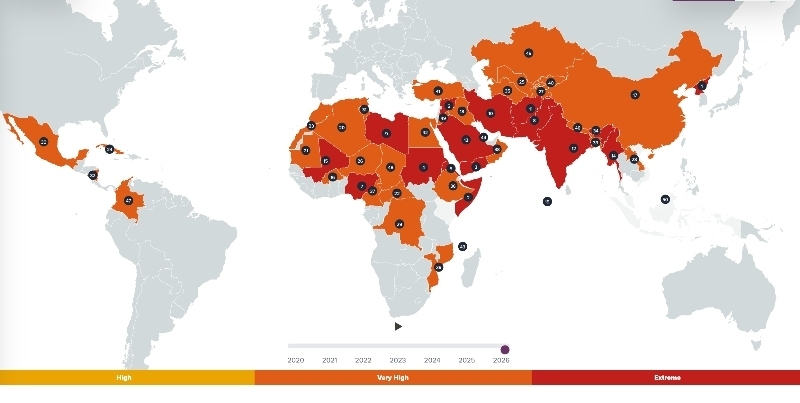
According to Christian Daily International, the findings identified worsening conditions in Iran, Pakistan, Egypt, China and Cuba. The editors also raised concerns about the political exploitation of religious identity, the use of faith to advance ideological agendas and Russia’s invocation of religion to justify its war against Ukraine.
“Religious freedom faces a twofold threat worldwide: from those who trample it underfoot, and from those who seek to marginalize it in international politics,” said Thomas Paul Schirrmacher, president of the International Institute for Religious Freedom and the International Society for Human Rights.
Schirrmacher warned that religiously motivated violence continues to expand in several regions, particularly in Africa, where extremist groups have increasingly targeted Christians and members of other religious communities.
“The horrifying reports of religious persecution show no sign of abating,” Schirrmacher said. “In Africa, for example, the killings of Christians, moderate Muslims and adherents of traditional religions by Islamist extremists are spreading geographically ever further.”
Beyond direct persecution, Schirrmacher expressed concern that governments and international institutions are giving less attention to religious freedom as geopolitical rivalries, military conflicts and energy interests dominate their priorities.
He cited conflicts and political instability in Ukraine, Ethiopia, Iran and the Middle East as examples of situations in which the protection of religious minorities has been overshadowed by broader strategic concerns.
To address these challenges, Schirrmacher called for greater cooperation among religious communities, political leaders and civil society organizations, advocating a “broad, interfaith alliance of politicians, parliamentarians, journalists, academics, religious leaders and human rights organizations.”
Johann Matthies, political representative of the Evangelical Alliance in Germany, highlighted the impact of Russia’s invasion of Ukraine on religious communities, pointing to the destruction of worship facilities and restrictions imposed on congregations in occupied territories.
“Ukraine shows just how much faith can come under attack,” Matthies said. “According to the Ukrainian Ministry of Foreign Affairs, more than 640 places of worship have been damaged or destroyed in the course of Russia’s war of aggression.”
Matthies also described reports of religious leaders facing harassment, detention and displacement in Russian-controlled areas, where congregations have struggled to maintain their activities.
“In the occupied territories, congregations are being dispossessed,” Matthies said. “Church services are being disrupted by raids. Clergy are being interrogated and sentenced to long prison terms. I have met pastors who have lost their churches and now live as displaced persons in their own country.”
He further criticized the Russian Orthodox Church leadership for presenting the military campaign in religious terms while Russian authorities portray their country internationally as a defender of Christianity.
“The leadership of the Russian Orthodox Church interprets the war of aggression as a ‘metaphysical struggle’ and equates death on the front line with the sacrifice of Christ,” Matthies said. “At the same time, Russia is portraying itself in the West as a defender of Christianity.”
Gudrun Kugler, an Austrian lawmaker and vice president of the OSCE Parliamentary Assembly, drew attention to the particular challenges faced by women belonging to religious minorities, who may experience discrimination because of both their religious affiliation and gender.
“It is all the more important to consider the various dimensions of persecution in a nuanced way,” Kugler said. “This also includes the gender-specific dimension. Women from religious minorities often experience persecution in a dual or multiple capacity – both as women and on account of their faith.”
Kugler said that although men are more frequently exposed to direct physical attacks, women from persecuted communities are especially vulnerable to forced marriages, kidnappings, sexual violence and exclusion from social life. “These forms of violence often remain invisible, yet have a profound impact on the lives of those affected and on the stability of entire communities,” she said.
Martin Lessenthin, a human rights expert and co-editor of the yearbooks, also warned that wars and political tensions have made religious persecution easier to conceal and overlook.
“Wars and political tensions have created a situation in which oppression, discrimination and persecution can be more easily concealed by the perpetrators and more easily ignored by decision-makers in democratic states. This disregard has reached its highest possible level.”