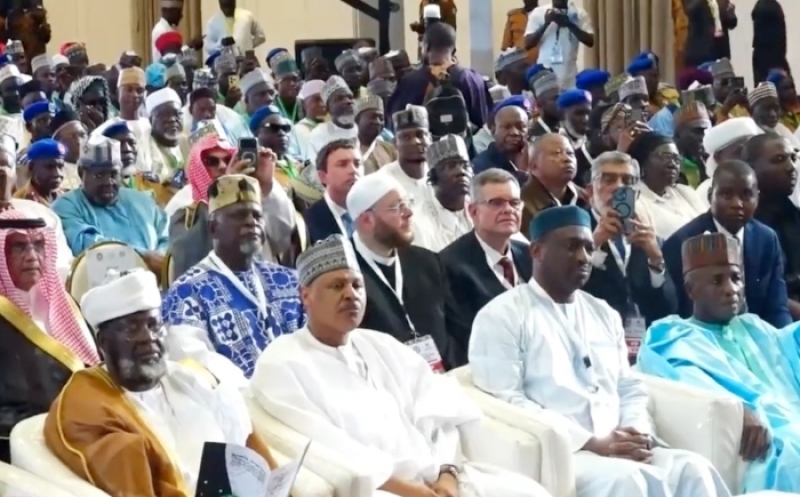
More than 50 Christian and Muslim leaders in Nigeria have signed a peace agreement designed to strengthen religious coexistence and discourage hate speech and extremism ahead of the country’s 2027 election.
The accord was signed Aug. 13 in Abuja at an event organized by the Saudi-based Muslim World League, which also announced the creation of a new interfaith body to encourage cooperation between Nigeria’s Christian and Muslim communities.
The initiative comes as Nigeria continues to face religious tensions shaped by years of violence and political divisions. While the north is predominantly Muslim and the south largely Christian, members of both faiths live across the country.
John Praise Daniel, chairman of the Northern Christian Religious Leaders’ Assembly, said the agreement could help religious leaders avoid inflammatory rhetoric. “No hate speech, and no disrespect for other religious groups, no calling of people as infidels,” Daniel said.
Khalid Abubakar, secretary-general of Jama’atu Nasri Islam, emphasized that the accord does not ask either side to compromise its faith. “It is not a call to leave your own religion, but a cooperation of working together in harmony,” he said.
Muslim World League Secretary-General Mohammad Al-Issa said the initiative demonstrated a shared desire to overcome religious division. “We do not deny that extremist ideas have harmed everyone; all have been affected by it,” Al-Issa said.
The Nigerian government expressed support for the agreement. Deputy Senate President Barau Jibrin represented President Bola Tinubu at the ceremony, which was also attended by three northern governors. “The government is determined to make sure that we remain united as a country, despite our differences, whatever the differences may be,” Jibrin said.
The accord urges greater mutual respect between faith communities and calls on religious leaders to reject inflammatory language.
Nigeria has endured years of attacks by Islamist insurgents, armed groups and other actors. Boko Haram and Islamic State West Africa Province have carried out violence for more than 15 years, killing thousands and displacing communities.
Christians have been among those targeted, but large numbers of Muslims have also been killed. Reuters reported that much of the insurgency has been concentrated in the predominantly Muslim northeast, where analysts and rights groups say Muslims constitute the majority of victims.
Nigeria’s broader security crisis extends beyond a simple Christian-Muslim divide. The U.S. Commission on International Religious Freedom has documented attacks by Islamist extremist groups, Fulani militants and other nonstate actors, along with religious discrimination and restrictions affecting multiple communities.
Tinubu’s ruling All Progressives Congress is again fielding a Muslim-Muslim presidential ticket, as it did in 2023, departing from the longstanding practice of balancing tickets between the country’s two largest religious communities.