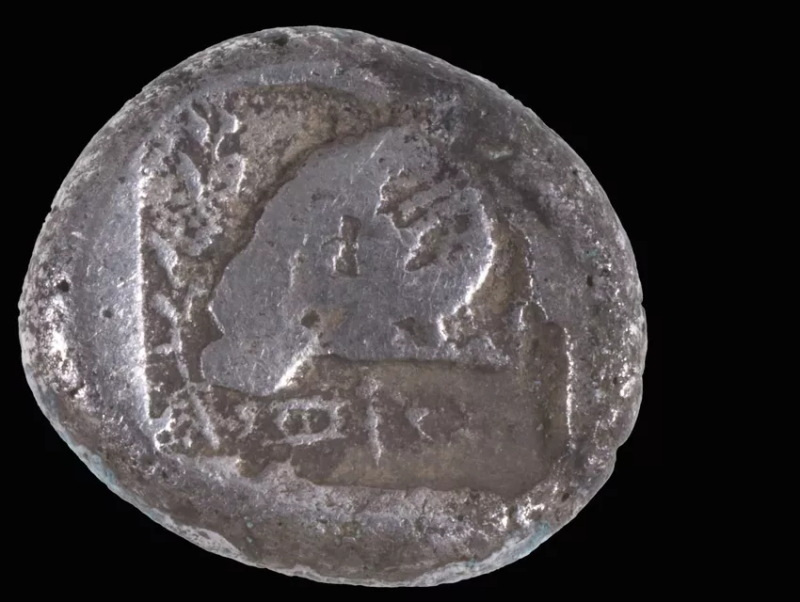
A rare coin struck in Cyprus about 2,500 years ago has been discovered on an Israeli beach, offering researchers fresh evidence of maritime trade and travel across the eastern Mediterranean during the biblical era.
The artifact was found last month along the shoreline of Ashdod in southern Israel by Avi Chaprak, deputy director of the city’s beaches department, according to a statement the Israel Ministry of Tourism provided to The Christian Post.
After examining the discovery, experts with the Israel Antiquities Authority determined that no comparable coin had previously been documented in Israel.
Researchers believe the coin was minted around the middle of the fifth century B.C. in Salamis, an ancient city on the eastern coast of Cyprus, when the island was under Persian imperial rule. Weighing approximately 11 grams, it is classified as a siglos, a denomination widely used throughout the Persian Empire.
Testing conducted by the Israel Antiquities Authority found that the coin consists of base metal covered with a layer of silver. Yanniv David Levy, a researcher and curator in the authority’s coin department, said similar silver-plating techniques have been identified on other Cypriot coins from the period, when silver was limited on the island.
Levy noted that complete Persian-era coins of this size and denomination are rarely preserved, making the discovery of an intact specimen at a coastal location particularly noteworthy.
One side of the coin depicts a reclining ram facing left. The reverse features the ram’s head facing in the same direction within a recessed square, along with an upright laurel branch and three symbols believed to be part of Cyprus’ ancient syllabic script.
Evangeline Markou, a specialist in ancient Cypriot coinage at the Institute of Historical Research of the National Hellenic Research Foundation in Athens, said coins produced in fifth-century Salamis circulated through ports across the eastern Mediterranean.
Because relatively few examples can be linked to a precisely documented discovery site, Markou said the Ashdod coin could provide new insight into commercial activity and human movement between Cyprus and the ancient Land of Israel.
Levy added that the accurate recording of where and how the coin was found allows researchers to identify it with greater confidence and use it as tangible evidence of the trade and seafaring networks that connected the region more than two millennia ago.
Ashdod has functioned as an important Mediterranean port for thousands of years. During the fifth century B.C., the city belonged to a Levantine coastal region governed by the Persian Empire, which also controlled Cyprus at the time.