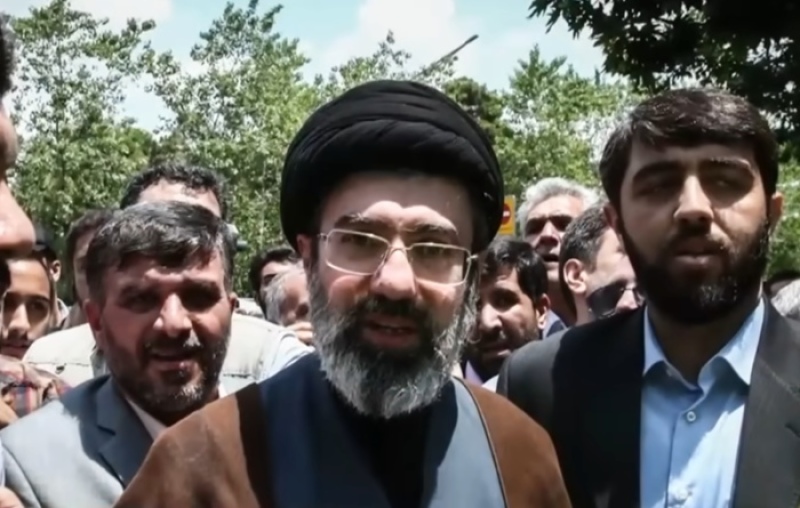
Mojtaba Khamenei has been appointed as Iran’s new supreme leader, elevating the son of the late Ayatollah Ali Khamenei to the country’s highest authority during a period of escalating conflict involving the United States and Israel across the Middle East.
Iran’s Assembly of Experts selected the 56-year-old cleric to replace his father following the elder Khamenei’s death on Feb. 28 during the early stage of the ongoing war, according to reporting by The Associated Press.
The appointment brings a relatively private and influential figure — long connected to Iran’s Islamic Revolutionary Guard Corps — into direct control of the Islamic Republic’s political and military leadership during a time of heightened regional instability.
Although Mojtaba Khamenei had never held a formal elected or government position, he had long been viewed as a possible successor to his father. Critics within Iran’s political circles have warned that a father-to-son transition could resemble the hereditary rule of the shah, whose monarchy was overthrown during the 1979 Islamic Revolution.
Nevertheless, many figures within Iran’s security and political establishment supported his selection, particularly as the country confronts a wartime crisis. Senior Iranian security official Ali Larijani reportedly told state television that Mojtaba Khamenei had been prepared for leadership by his father and possessed the ability to guide the nation through the current conflict.
Iran’s Revolutionary Guard publicly endorsed the new leader, while Hezbollah, the Iranian-backed militant group based in Lebanon, also issued statements expressing support.
Analysts say Mojtaba Khamenei is aligned with Iran’s hardline political faction and could pursue an even stricter governing approach. Citing Iranian officials and analysts familiar with the situation, The Wall Street Journal reports that he “would likely opt for an even more hardline direction as supreme leader,” and one Iranian official described him as “much tougher than his father.”
For years, Mojtaba Khamenei has maintained close ties to Iran’s security and power structures, particularly institutions responsible for shaping the country’s military policies and foreign relations.
According to research from the Carnegie Endowment for International Peace, he was closely involved in the government’s response to the 2009 Green Movement protests, working alongside the Basij paramilitary forces as authorities moved to suppress demonstrations following the disputed presidential election. The protests represented the largest political challenge to Iran’s leadership since the 1979 revolution before being forcefully contained by security forces.
Carnegie researchers also note that before his death, Ali Khamenei reshaped several key political institutions to ensure that conservative factions maintained control. Through the Guardian Council, hundreds of candidates — including many moderates and reformists — were disqualified from the March 2024 elections to the Assembly of Experts.
Saeid Golkar, a specialist on Iran’s security services at the University of Tennessee at Chattanooga, told The Wall Street Journal that if Mojtaba Khamenei consolidates power, “He will take his father’s revenge against both Iranian society as well as Israel and the United States.”