A new analysis from the Pew Research Center finds that Christianity remains the most geographically widespread faith in the world, while the United States stands out for its level of religious diversity among the globe’s most populous countries.
Although the U.S. ranks 32nd worldwide on Pew’s Religious Diversity Index, it holds the top spot among the 10 most populous nations, each with at least 120 million residents.
The findings come from Pew’s Global Religious Futures project, which evaluated the religious makeup of 201 countries and territories as of 2020. Researchers categorized populations into seven groups — Christians, Muslims, Hindus, Buddhists, Jews, followers of other religions and the religiously unaffiliated — and calculated diversity scores based on how evenly these groups are represented within each nation.
Among the 10 largest countries by population, the United States recorded the highest Religious Diversity Index score at 5.8. Nigeria, Russia, India and Brazil followed in descending order.
As of 2020, Christians comprised about 64% of the U.S. population. Roughly 30% identified as religiously unaffiliated, while Muslims, Hindus, Buddhists, Jews and adherents of other religions collectively accounted for approximately 6%, with each group representing between 1% and 2%.
Nigeria ranked second among the largest nations in religious diversity. In that country, Christians and Muslims each make up more than 40% of the population.
Pakistan, by contrast, emerged as the least diverse among the 10 largest countries. With Muslims representing about 97% of its population, it earned a Religious Diversity Index score of 0.8.
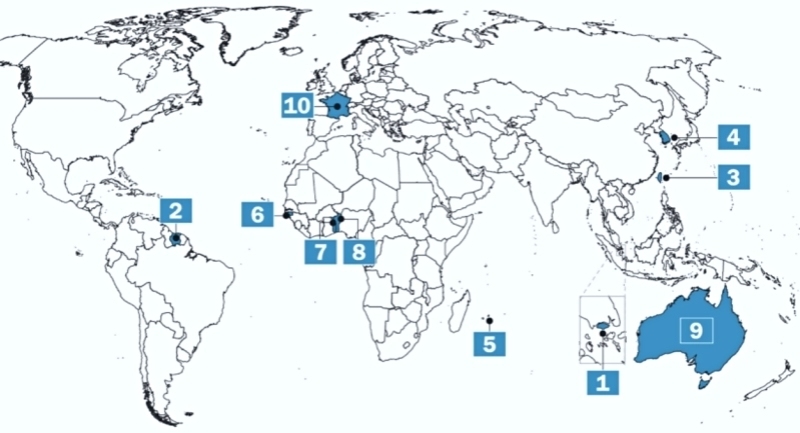
Globally, Singapore posted the highest diversity score at 9.3 out of 10, reflecting a near-even distribution across the seven religious categories included in the study.
Suriname placed second overall and stands as the only Latin American nation within the top 10 most religiously diverse countries.
The remaining top 10 countries are largely concentrated in the Asia-Pacific region — including Taiwan, South Korea and Australia — and sub-Saharan Africa, such as Mauritius, Guinea-Bissau, Togo and Benin.
France is the sole European country among the top 10 most diverse nations. Its population is composed of 46% Christians, 43% religiously unaffiliated individuals and 9% Muslims.
Despite these examples of pluralism, Pew’s research indicates that most countries are dominated by a single religious group.
In 194 of the 201 countries and territories analyzed, at least half of the population belongs to one religious category. In 43 countries, 95% or more of residents adhere to the same religion. These nations are predominantly Muslim, Christian or Buddhist.
Yemen, Afghanistan and Somalia are identified as the least religiously diverse countries in the world, with Muslims accounting for 99.8% or more of their populations. Timor-Leste and Moldova also rank among the least diverse, with populations that are overwhelmingly Christian.
Only seven countries lack a single religious majority: the United Kingdom, Mauritius, South Korea, Australia, France, Ivory Coast and Singapore.
On a regional level, the Asia-Pacific region is the most diverse, earning an overall Religious Diversity Index score of 8.7. No single religious group forms a majority there, and the religiously unaffiliated constitute roughly one-third of the population.
North America, sub-Saharan Africa and Europe fall into the “high diversity” classification, with scores of 6.0, 5.9 and 5.6 respectively. In each of these regions, Christians represent the largest religious group. The religiously unaffiliated rank second in North America and Europe, while Muslims hold that position in sub-Saharan Africa.
Latin America and the Caribbean are considered moderately diverse, with a score of 3.1, reflecting a strong Christian majority alongside a smaller unaffiliated segment.
The Middle East and North Africa region is the least diverse globally, registering a score of 1.3. Approximately 94% of the population in that region identifies as Muslim, and it includes five of the 10 least religiously diverse countries worldwide.
According to Pew’s findings, Christians are the most widely distributed religious group geographically. While many Christians reside in moderately diverse nations, large populations also live in highly diverse countries such as the United States, Nigeria and Ethiopia.
Between 2010 and 2020, global levels of religious diversity remained largely unchanged.
In the United States, however, diversity increased from the “moderate” to the “high” category over the decade. This shift was driven by a 14-percentage-point decline in the Christian share of the population to 64%, alongside growth in the religiously unaffiliated population.