Global leaders convened in Washington this week to address the future of the Gaza Strip, with several nations announcing major financial commitments aimed at stabilizing and rebuilding the conflict-ravaged territory.
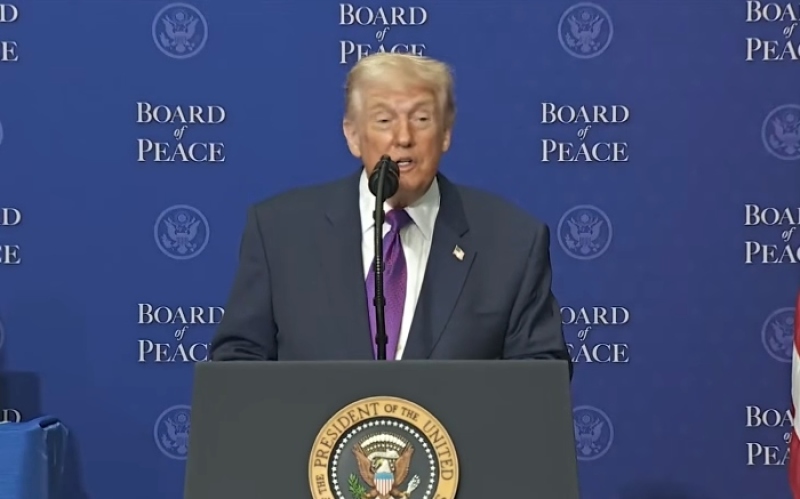
President Donald Trump hosted the inaugural session of the newly formed Board of Peace on Thursday.
During the meeting, Trump highlighted contributions already pledged by multiple countries. He said Kazakhstan, Azerbaijan, the United Arab Emirates, Morocco, Bahrain, Qatar, Saudi Arabia, Uzbekistan and Kuwait have collectively provided more than $7 billion in support of relief and redevelopment efforts in Gaza. The United States, he added, will commit $10 billion to the initiative.
Trump also referenced additional humanitarian assistance flowing into the region. The United Nations Office for Coordination of Humanitarian Assistance has raised $2 billion, he noted. “Additionally, Japan has just committed to host an aid fundraiser, which will be a very big one,” he said. He further stated that South Korea, the Philippines and Singapore intend to participate in the fundraising effort.
Beyond direct relief funding, sports infrastructure emerged as a symbolic and practical component of the redevelopment plan. FIFA has agreed to partner with the Board of Peace to construct 50 mini football pitches across Gaza at a cost of $2.5 million, as well as five full-size fields costing $1 million each. The organization will also invest $15 million to establish a FIFA Academy.
Plans also include the construction of a national stadium with a projected capacity of 20,000 to 25,000 spectators, estimated to cost $50 million.
Security arrangements were another focal point of the meeting. Trump announced that several member countries would contribute personnel to help maintain order and stability in Gaza.
“Albania, Kosovo and Kazakhstan have all committed troops and police to stabilize Gaza. Egypt and Jordan are likewise providing very, very substantial help: troops, training and support for a very trustworthy Palestinian police force,” he explained.
Participants also discussed a proposed infrastructure corridor known as the Abrahamic Gateway. The project would connect Gaza to neighboring Egypt, Israel, Jordan, Saudi Arabia and the United Arab Emirates, with extended links reaching India and Europe.
A presentation shown at the event projected long-term transformation for the territory. “By year 10, Gaza will be self-governed, integrated into the region with thriving industries and housing for all. This is the framework for Gaza’s rebirth: secure, prosperous and peaceful,” the video predicted.
Leaders of participating nations outlined additional commitments. Kazakhstan’s president pledged to offer 500 scholarships to Palestinian students over five years to study at universities in his country. Indonesia’s president announced plans to deploy at least 8,000 troops as part of stabilization efforts.
The Board of Peace was authorized by the U.N. Security Council under Resolution 2803 and formally introduced last month at the World Economic Forum in Switzerland. The body is structured as a transitional administration with international legal standing, tasked with coordinating funding and implementing the broader peace and reconstruction plan aimed at ending the Israel-Hamas conflict.


