A 35-year-old British driver says his car insurance was canceled after his insurer objected to two Christian messages displayed on his vehicle.
Simeon Chandra was told by GoSkippy that it had “declined the modification” and was asked to provide photographic proof that the messages had been removed, according to the Christian Legal Centre, which is supporting him.
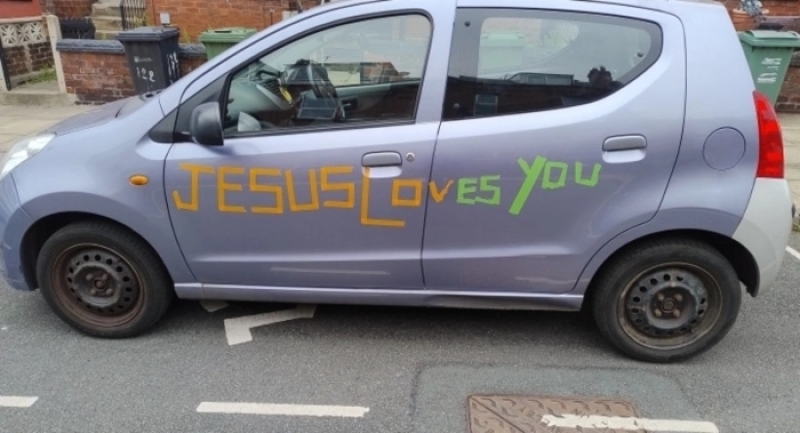
Photos of Chandra’s 2009 Nissan Pixo show “Jesus loves you” written in green tape on one side and “Jesus loves you v much” on the other, The Telegraph reported. After he submitted pictures to the insurer, he was warned that his policy would be voided unless the messages were taken off.
GoSkippy reportedly told Chandra in writing that its underwriting team considered the stickers an unauthorized vehicle modification. The company added, “For the policy to continue and be insured we require the stickers to be removed from the vehicle and [to] send a dated photograph once the stickers have been removed.”
Chandra said the insurer did not explain why the messages were rejected.
He said he was “shocked, surprised and upset” by the demand and argued that it interfered with his freedom of religion and expression. He described the words as a peaceful message of hope rather than something political, hateful or commercial.
Chandra also said the company had not responded to his emails.
He hopes to put the messages back on his car and encourage other Christians to express their faith openly. Chandra argued that if his stickers are prohibited, insurers should apply the same rule to all vehicle stickers.
“I was shocked, surprised and upset when they told me I had to take the stickers off. I had tried to do the right thing by telling the insurer about the stickers and sending photographs,” Chandra said in a statement shared by the Christian Legal Centre. “The message on my car is very simple: ‘Jesus Loves You.’ It is not abusive, political, hateful or commercial. It is a message of hope.”
“I could not understand why this would mean I could not have car insurance,” he continued. “We see all kinds of messages, flags and slogans in public life. But when a Christian puts a peaceful message on his own car, suddenly it appears to become a problem.”
Chandra is consulting lawyers with the Christian Legal Centre about possible legal action.
He became a Christian while attending university and was raised in a family of Indian heritage whose parents served as Christian missionaries. His father converted from Hinduism to Christianity, while his mother became a Christian after she said an injured leg was healed during a church service.