Republican members of the U.S. House Judiciary Committee are raising concerns that South Korea’s amended “fake news” law could threaten the free speech rights of American citizens and companies.
Committee Chairman Jim Jordan, R-Ohio, and three other Republicans sent a letter Thursday to Kim Jong-cheol, chairman of the Korea Media and Communications Commission (KMCC), criticizing changes to South Korea’s Information and Communications Network Act.
The lawmakers said the amendment, passed by the National Assembly last December and implemented last month, “[gives] courts the unprecedented power to punish news outlets and social media users for spreading ‘false or manipulated information’ and extract damage awards of up to five times any alleged harm.” They also warned that the KMCC can now “impose massive fines on news outlets and users that it deems to have spread such information.”
Under the amended law, the KMCC can impose fines of up to 1 billion won ($656,000) on those who distribute information more than twice after a Korean court has ruled it false or manipulated.
“This amendment serves as a major threat to online speech and expression and would allow the KMCC to punish American companies and their users for exercising their constitutionally protected rights,” the lawmakers wrote.
They argued that the law could directly affect U.S.-owned platforms including YouTube, Facebook, X and Instagram.
“As such, the amendment could force American companies to remove speech that South Korea deems ‘false or manipulated’ or face massive fines and penalties for failing to comply, giving South Korea the ability to coerce American businesses into removing politically disfavored speech, including the speech of American citizens that may be available in South Korea or shared by South Korean users,” the letter stated.
The lawmakers requested a briefing from South Korean officials by Aug. 20. Reps. Darrell Issa, R-Calif., Scott Fitzgerald, R-Wis., and Michael Baumgartner, R-Wash., also signed the letter.
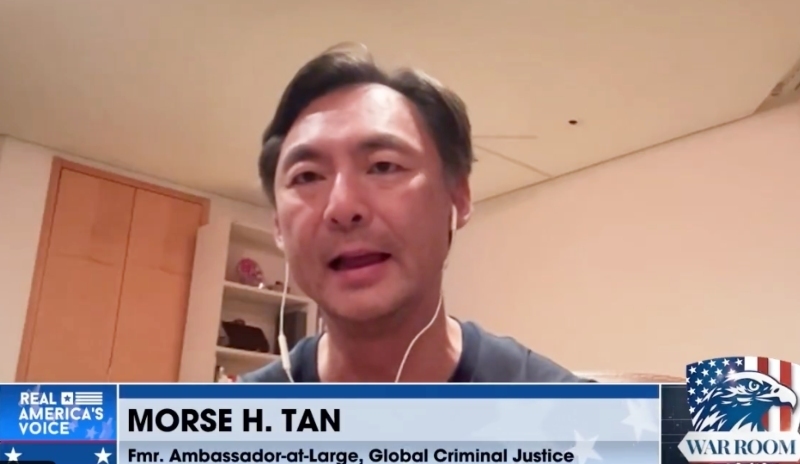
Their concerns come as Morse H. Tan, who served as U.S. ambassador-at-large for global criminal justice from 2019 to 2021, remains barred from leaving South Korea after being indicted last month under the Information and Communications Network Act.
Tan is scheduled for his first court hearing Sept. 11 and faces potential imprisonment over remarks he allegedly made about South Korean President Lee Jae Myung during an event at the National Press Club in Washington, D.C.
Speaking Tuesday on Steve Bannon’s “War Room” podcast, Tan said, “Three successive travel bans have been imposed on me because I have been leading the counterrevolutionary movement against the communizing coup d’état and the subsequent purge currently happening in South Korea.”
In another “War Room” interview Thursday, Tan again claimed that the South Korean government’s actions against him were retaliation for his opposition to what he described as “the communizing coup d’état and the subsequent purge currently happening in South Korea.”


