Oklahoma residents will vote in November to decide if an article of state constitution can be abolished to pave the way for the return of a Ten Commandments monument on the Capitol grounds.
A constitutional amendment was passed in Oklahoma Senate by 39-5 to ask residents to vote on restoring a Ten Commandment monument on the Capitol grounds. The House has also approved the proposal 65-7.
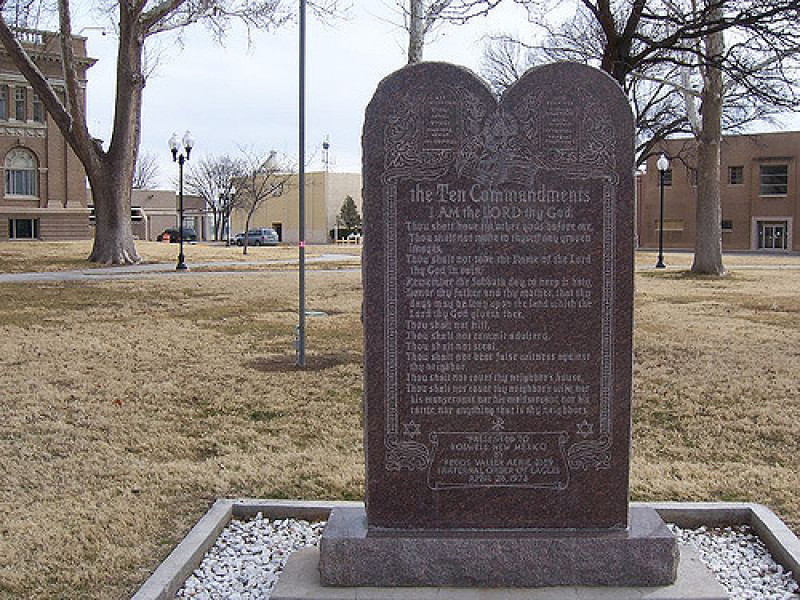
The 6-foot-tall granite monument of Ten Commandments was moved from the Capitol grounds after the state Supreme Court ruled that its presence was unconstitutional, citing an article of constitution which prohibits the use of state funds for endorsement of a religion.
The voters will determine if the article can be abolished so that state funds could be directed to support religion.
The privately funded monument was the authorized by state legislature in 2009, and was erected in 2012. A lawsuit was filed for its removal by Bruce Prescott, who is a Baptist minister, on the grounds of violation of state constitution.
When the monument was removed, it angered some Republican lawmakers who said that they would restore the monument.
"Since the Oklahoma Supreme Court's decision in June regarding the Ten Commandments monument, my constituents wanted to know what could be done," Rep. John Paul Jordan (R-Yukon) was quoted as saying by Associated Press. "I knew it would be a difficult proposition to undo the ruling, so we looked at giving voters the opportunity to remove the basis for the ruling."
After the monument was built, other groups also inquired about space to place their monuments on the Capitol grounds. A satanic church in New York, a Hindu leader from Nevada, and a 'Church of the Flying Spaghetti Monster,' were among those groups.
The American Civil Liberties Union, who represented Prescott, will challenge the monument in federal court, if it returns after the referendum.
Applications can be submitted by religious groups for putting monuments at the Capitol, but a decision to have them erected has been postponed till later.
When the Oklahoma Supreme Court banned religious displays at the statehouse, the groups started lobbying for statue spaces at Arkansas Capitol, which has also set up its Ten Commandment display.
Arkansas legislature passed the bill to display Ten Commandments on the basis of its historical significance, and not on the grounds of religion.
"We don't want just every group putting a statue on the Capitol grounds," said Arkansas Governor Asa Hutchinson. "We want it to be exclusive, we want it to be reasoned, we want it to be reflective and I think that's one of the reasons [the Ten Commandments monument] went through the legislative process to accomplish that."