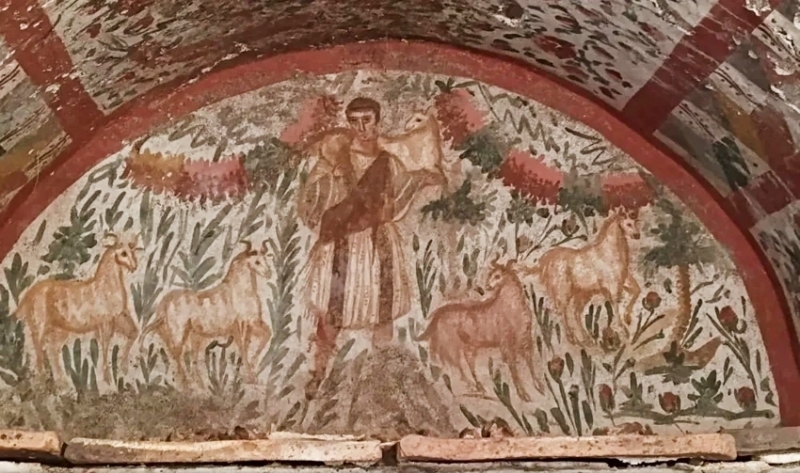
Archaeologists working in Turkey have uncovered a rare third-century mural portraying Jesus as the “Good Shepherd,” offering new insight into early Christian art and belief.
The artwork, which is notably well preserved, forms the central image among several frescoes found inside an underground burial chamber in the Hisardere necropolis near the modern town of Iznik.
Although Iznik may be unfamiliar to many today, the city is historically significant to Christianity under its ancient name, Nicaea.
In A.D. 325, Nicaea hosted the First Council of Nicaea, a defining moment in Christian history. Convened by Constantine the Great, the gathering brought together church leaders from across the Roman world to address foundational theological disputes.
That council produced the Nicene Creed, a core statement of Christian belief that remains foundational for Catholic, Protestant, and Orthodox traditions.
The newly revealed mural depicts Jesus as a youthful figure dressed in a plain tunic, carrying a sheep across his shoulders in the traditional “Good Shepherd” pose. He is also shown holding a date palm, a symbol associated with eternal life and resurrection in early Christian symbolism.
Additional frescoes within the tomb portray scenes from elite Roman life, including an aristocratic couple laid out on a funerary platform and a banquet-style symposium attended by servants. Notably absent are crosses, reflecting the caution early Christians often exercised in visual expression during periods of persecution.
Although the mural was initially discovered earlier last year, details of the find were not publicly released until November, shortly after Pope Leo XIV visited Iznik.
The pontiff’s trip marked the 1,700th anniversary of the Council of Nicaea. During the visit, Turkish officials reportedly presented the pope with a tile reproduction of the fresco by Turkish President Recep Tayyip Erdoğan.
Archaeologists hope that the discovery will provide greater insight into the lives of early Christians, and plans are underway to begin restoration work on the ancient artwork.


