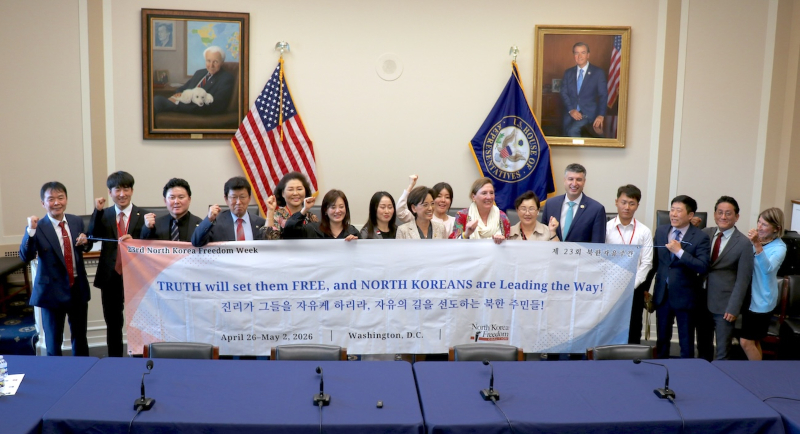
Congressional Roundtable During North Korea Freedom Week Focuses on Forced Repatriation and Information Flow into North Korea
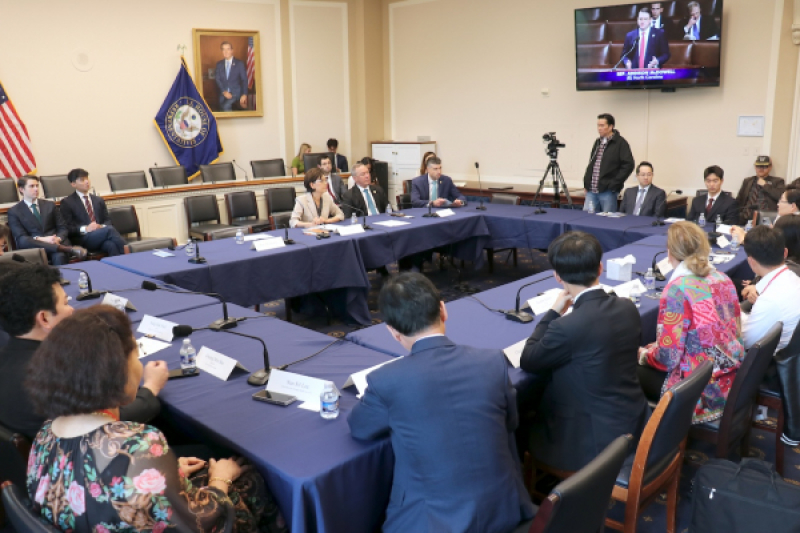
On the afternoon of April 29, the fourth day of the 23rd North Korea Freedom Week, a “North Korea Freedom Week Delegation Congressional Roundtable” was held at 2:30 p.m. at the Rayburn House Office Building in Washington, D.C. The event was co-hosted by Rep. Young Kim (R-CA) and Rep. Ami Bera (D-CA).
The roundtable was attended by North Korea Freedom Week Chair Susan Sholty, a delegation of North Korean defectors, and U.S. lawmakers. Participants exchanged testimonies and questions regarding the realities of life inside North Korea, the impact of information flowing into the country, the crisis of human trafficking and forced repatriation facing North Korean women in China, and the issue of North Korean troops deployed to Russia.
In particular, the reauthorization of the North Korean Human Rights Act was at the center of the day’s discussions. Enacted in 2004, the North Korean Human Rights Act has supported the promotion of human rights for North Korean citizens, the expansion of access to information, the protection of defectors, and the support of information flow into North Korea. Congresswomen Young Kim and Ami Bera are pushing for the reauthorization of the North Korean Human Rights Act to ensure that the human rights situation of North Korean citizens continues to be addressed at the U.S. congressional level.
The Influx of External Information and Changes in North Korean Citizens’ Perceptions
Kim Ji-young, CEO of Radio Free North Korea, presented the results of a recent survey conducted by the organization among 75 North Korean defectors in their 30s and 40s who entered South Korea since 2022.
Representative Kim stated, “66% of respondents reported accessing external information at least once a week, and said that this information gave them dreams of freedom and the courage to defect.” She added, “All respondents believed that the Kim Jong-un regime enacted the Youth Education Guarantee Act, the Law on Rejecting Reactionary Ideology and Culture, and the Pyongyang Cultural Language Protection Act out of fear of regime collapse and the impossibility of maintaining dictatorship.”
Kim continued, “North Korean residents are that eager for external information,” emphasizing, “When they persistently do what Kim Jong-un hates most, the dictatorship will be shaken, and North Korean residents will find a way to survive.”
The impact of the influx of external information was also a major topic during the subsequent Q&A session. Representative Kim explained, “It can be assumed that a significant number of North Korean residents have been exposed to external information at least once or twice,” adding, “External information is entering North Korea through the Yalu River border, overseas workers, soldiers deployed to Ukraine, and broadcasts targeting North Korea near the DMZ.”
He further remarked, “In North Korea, there is even a saying that anyone who hasn’t watched South Korean dramas since 2010 is out of touch with the times,” adding, “The fact that the Kim Jong-un regime enacted the so-called ‘Three Evil Laws’ is proof that external information is shaking the North Korean system.”
Testimony from a North Korean defector: “I left to survive, and I learned about freedom through external information.”
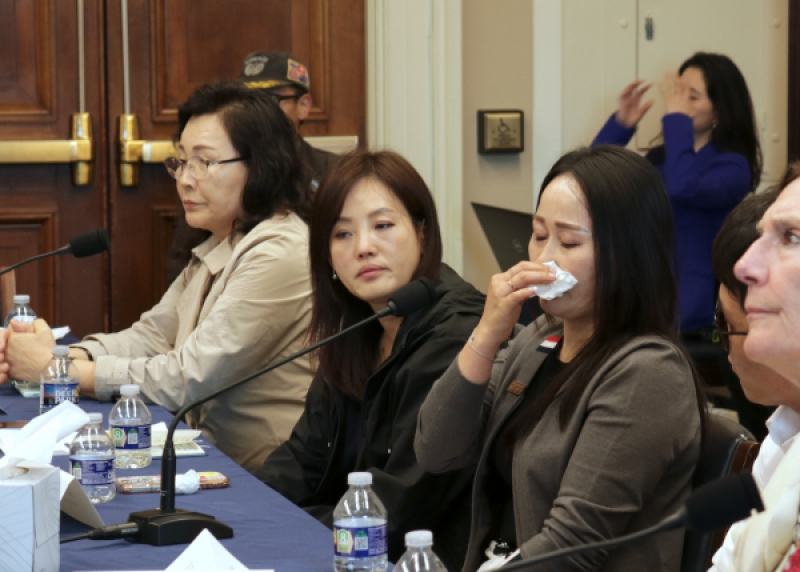
During the roundtable discussion that day, testimonies were shared by recent North Korean defectors and human rights activists.
Mr. Choi Chun-hyuk described the reality faced by North Korean fishermen who venture into Russian waters to make a living and are subsequently arrested. “I was seized by the Russian maritime police and spent two years and one month in detention,” Mr. Choi testified. “At first, I thought I would rather die than return to my homeland, but after being exposed to the Korean Wave and information from the outside world, I realized that if I returned to North Korea, I could not escape torture by the State Security Department and life in prison.”
He explained that he decided to apply for refugee status out of fear that not only he but also his family would face punishment if he returned to North Korea, and revealed that he was able to settle in South Korea with the help of international human rights organizations.
Lee Jae-hee shared his experience of losing his parents at a young age, moving from one relative’s home to another, and enduring harsh labor in the Youth Shock Brigade. “I worked in terrible conditions where they didn’t even provide proper gloves or shoes, eating only corn porridge,” he said. “At that time, my greatest wish was to eat a single bowl of warm rice.”
The issues of human trafficking and forced repatriation of North Korean women in China were also raised. Ms. Lee Soon-sil shared her experience of repeatedly facing human trafficking and forced repatriation in China, pleading, “Once you are sold, you are treated like a commodity.” She added, “I set out on the road for a single meal without even knowing what freedom was, and it was only after coming here that I came to understand what freedom truly means.”
She urged, “North Korean women and children are suffering the most severe harm in the most vulnerable positions,” adding, “The entire world must unite its voices to rebuild North Korea’s shattered human rights.”
Discussions on North Korea-Russia Military Cooperation and the Dispatch of North Korean Troops
The issue of North Korean troops deployed to Russia was also a key agenda item at the roundtable. Choi Jeong-hoon, commander of the North Korean People’s Liberation Front, pointed out that North Korean youths are being sent to the battlefields in Russia, stressing that this issue should be viewed not merely as military cooperation but as a serious human rights issue.
Choi stated, “Young North Koreans are being sent to the Russian battlefield, and because they know that if they are taken prisoner, their families left behind in North Korea will be executed, some are even taking their own lives,” adding, “This is another human rights violation rarely seen anywhere else in the world.”
He expressed concern that North Korean prisoners of war held in Ukraine would likely not be guaranteed their lives if they returned to North Korea. Representative Choi stated, “If they return, they will die 100%,” and requested, “If the South Korean government remains silent, I ask the U.S. government and Congress to urge the Ukrainian government to help them regain their freedom.”
In response, Congresswoman Young Kim indicated that she would revisit this issue during her upcoming meeting with the U.S. Ambassador to South Korea.
Attending Federal Lawmakers Call for South Korea and the U.S. to Join Forces Again
U.S. lawmakers who attended the roundtable also responded to the testimonies of North Korean defectors.
U.S. Representative James Moylan (R-Guam), who represents Guam, said he had previously heard similar testimonies during the 21st North Korea Freedom Week and expressed concern that little has changed since then, adding that South Korea and the United States must work together again to bring about meaningful change in North Korea and that he would strive to ensure progress does not take another 30 years.
U.S. Representative Derek Tran (D-CA) shared his experience of serving in the U.S. Army in Korea when he was 19 years old and displayed a commemorative frame of the DMZ barbed wire fence that he received at that time.
He explained that the frame was produced to commemorate the 50th anniversary of the outbreak of the Korean War, adding that the stories of those who escaped in search of freedom and human dignity serve as a reminder that the freedoms and dignity many take for granted are not guaranteed.
Rep. Young Kim Pledges Effort to Reauthorize the North Korean Human Rights Act
At the conclusion of the roundtable, Rep. Young Kim made it clear that she intends to translate the testimonies of North Korean defectors into legislative action.
Young Kim said that after hearing testimonies from both longtime defectors and those who had recently escaped, she was once again struck by how little conditions in North Korea have changed over time, adding that as access to outside information has increased, the importance of information flow into the country has grown even more significant.
She emphasized that many young people decide to defect after being exposed to outside information, noting that such broadcasts provide both encouragement and practical support, and added that the testimonies shared underscored the need for unified efforts in Congress to reauthorize the North Korean Human Rights Act.
Kim further highlighted that a key component of the legislation is the allocation of resources for broadcasting into North Korea, while expressing appreciation for Free North Korea Radio and its efforts to deliver messages despite significant risks.
She also explained that the goal of such broadcasting extends beyond sharing information to offering hope and courage to North Korean citizens, urging that the work continue despite difficulties so that those living in North Korea can hear these voices and be encouraged.
Young Kim said it was heartbreaking that conditions in North Korea have not improved over the decades and have instead deteriorated, adding that much more work remains to be done.
She also noted that she personally still has significant responsibilities ahead and pledged to serve as a voice for defectors, engage more actively with fellow lawmakers, and work diligently to secure the reauthorization of the North Korean Human Rights Act.