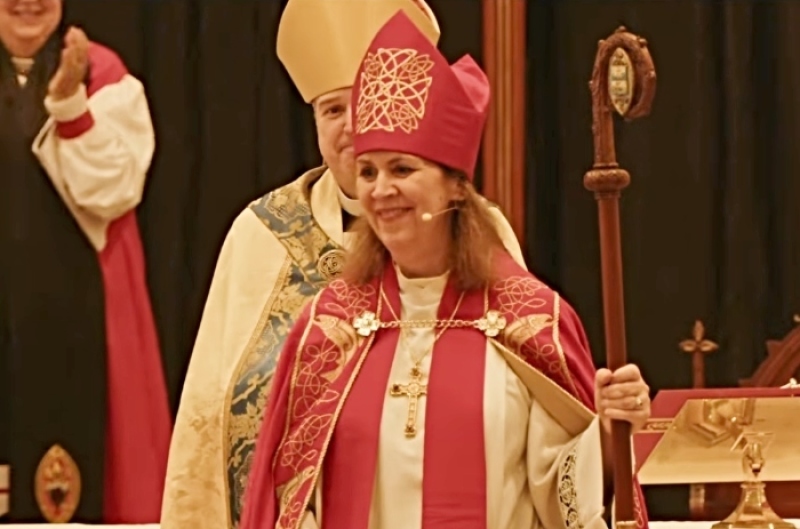
The Rev. Sarah Fisher has officially assumed leadership of the Episcopal Diocese of East Carolina as the first openly lesbian woman in a same-sex relationship to serve as a diocesan bishop in The Episcopal Church in the American South.
Fisher, whose spouse is the Rev. Mandy Brady, was installed Saturday as the ninth bishop of the North Carolina-based diocese during a service attended by church leaders and clergy from across the denomination.
While the Episcopal Church has previously consecrated openly gay bishops, denominational officials indicated that Fisher’s appointment represents a first for a southern diocese. A church spokesperson told The Christian Post, “Bishop Fisher is the first openly lesbian Episcopal Church bishop for a diocese based in the South.”
The installation ceremony was led by Presiding Bishop Sean Rowe, who served as chief consecrator. The sermon was delivered by Robert Wright, according to reports from Episcopal News Service.
Fisher secured election to the episcopate in November after delegates voted through three rounds of balloting. She ultimately received 36 clergy votes and 70 lay votes, surpassing the threshold required for election.
Now 54 years old, Fisher entered ordained ministry in 2005 through the Diocese of Atlanta. Her academic background includes a Bachelor of Arts degree from Agnes Scott College and a Master of Divinity from The General Theological Seminary.
Before her election, Fisher served as rector of St. Catherine’s Episcopal Church in Marietta, Georgia. She succeeds Bishop Rob Skirving, whose retirement concluded more than a decade of leadership in the diocese.
In 2003, the Rev. Gene Robinson became the first openly gay bishop in The Episcopal Church when he was elected to lead the Episcopal Diocese of New Hampshire, a decision that sparked significant controversy throughout the Anglican world and prompted numerous theologically conservative congregations to separate from the denomination.
The disputes resulted in years of legal battles over church buildings, financial assets and denominational property ownership.
The denomination has also experienced a prolonged decline in membership during the past two decades. Church statistics show that membership fell from approximately 2.1 million in 2006 to about 1.54 million by 2023.


