ICKS Calls for Immediate Congressional Action to Renew North Korean Human Rights Act at Annual Conference
The International Association of Korean Studies (ICKS, President Greg Scarlatoiu) co-hosted an annual conference with the Hudson Institute and the Committee for Human Rights in North Korea (HRNK), where the issues of North Korean abductions and transnational repression were extensively discussed.
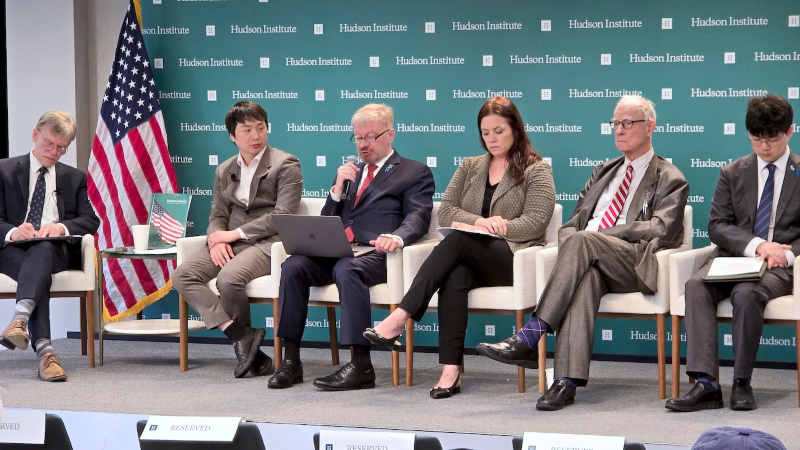
At the “Challenges to the US-ROK Alliance in 2026” conference held on April 30 at the Hudson Institute in Washington, D.C., where various topics related to North Korean human rights were discussed, the first morning panel was held under the theme “Abductions and Transnational Repression.” George Hutchinson, Editor-in-Chief of the International Journal of Korean Studies (IJKS), moderated the session. Presenters included Jaewoo Jay Park of Radio Free Asia (RFA), Greg Scarlatoiu, President of ICKS and Director of HRNK, and Amanda Mortwedt Oh, a researcher at ICKS. Journalist Donald Kirk and Raymond Ha, a researcher at ICKS, participated as discussants.
The panel drew attention for addressing the issue of abductions by North Korea not merely as a matter of history or a humanitarian issue, but by examining the current suffering of the victims’ families, the systematic involvement of North Korean intelligence agencies, the potential for accountability under international law, and future challenges for trilateral cooperation among South Korea, the United States, and Japan.
In his opening presentation, Jay Park spoke on the topic of “Abductions: A Victim-Centered Approach.” In his presentation, he highlighted the suffering endured by the families of abduction victims across generations and emphasized the need for a victim-centered approach.
In particular, Jay Park pointed out the reality of low public interest in South Korean society and the fact that the abduction issue is not sufficiently raised in inter-Korean dialogue. He stated that although the same problem has been recurring, there have been few resolved cases, leading to a decline in public interest in South Korea, adding that if U.S.-North Korea dialogue resumes, it is necessary to raise the abduction issues of South Korea and Japan together as agenda items.
In the second presentation, Greg Scarlatoiu spoke on the topic “Abductions: A Perpetrator-Focused Approach,” analyzing abductions as state-sponsored operations carried out by North Korean intelligence agencies. He explained that North Korea’s abduction of foreigners was not merely a series of spontaneous crimes or isolated incidents, but rather a systematic program designed for training operatives, identity theft, and conducting overseas operations.
Citing cases where the identities of Japanese abductees were exploited by North Korean operatives, Greg Scarlatoiu pointed out that North Korea used abductions as a means to secure operational identities and expand the mobility of its operatives abroad. He further emphasized that North Korea’s abductions abroad were systematically planned, executed, and justified by the state, adding that the issue goes beyond individual tragedy and constitutes a crime against humanity that requires accountability.
He viewed the issue of abductions as a prime example of why North Korean human rights and national security cannot be viewed separately. He explained that, from the perspective of North Korean intelligence agencies, abductees were individuals who could provide information on foreign languages, cultures, lifestyles, and identities, and that this is why North Korea has concealed their whereabouts and whether they are alive or dead.
Moderator and Editor-in-Chief Hutchinson assessed Scalatu’s presentation by stating that it revealed the operational structure, intelligence agencies, and state-led mechanisms that made the victimization possible, adding that it also exposed the process of concealing the victims’ fates.
The third presenter, Amanda Motwet Oh, analyzed abductions by North Korea from the perspective of violations of international law. Prefacing her remarks by stating she was speaking in a personal capacity, she explained that North Korea’s abductions are an issue situated at the intersection of international human rights law, international criminal law, and state responsibility.
Researcher Oh stated that North Korea’s abductions are ongoing crimes against humanity that give rise to both individual criminal liability and state responsibility, adding that while traditional enforcement measures have their limitations, universal jurisdiction and civil litigation can serve as meaningful avenues for holding perpetrators accountable, albeit partially.
She categorized the abduction issue into several distinct periods: the Korean War and the subsequent failure to repatriate South Korean POWs and civilians; abductions of foreign civilians from countries such as Japan, South Korea, and Romania since the 1970s; and the recent abductions and detentions of missionaries. In particular, she pointed out that South Korean POWs who were not repatriated after the Korean War were subjected to forced labor and ideological indoctrination in North Korea, and that even their children faced social discrimination.
Researcher Oh explained that North Korea’s abductions can be viewed as enforced disappearances under international law. She said enforced disappearance refers to cases where a state deprives an individual of their liberty, fails to acknowledge the detention, and conceals the victim’s fate and whereabouts, adding that victims of North Korean abductions have been placed outside the protection of the law in precisely this manner.
Furthermore, citing the fact that North Korea is a signatory to the International Covenant on Civil and Political Rights (ICCPR), she pointed out that abductions not only violate fundamental rights such as freedom of the person, the prohibition of arbitrary detention, and the recognition of legal personality, but also constitute a violation of sovereignty—involving the removal of civilians from foreign territory—and a breach of the principle of non-interference in internal affairs.
Measures for holding North Korea accountable included the International Criminal Court (ICC), the International Court of Justice (ICJ), domestic civil litigation, and universal jurisdiction. Researcher Oh noted that while referral to the ICC would require a referral to the UN Security Council—since North Korea is not a party to the ICC—the veto power held by China and Russia poses a practical obstacle. She explained that while the ICJ could also serve as a channel for resolving disputes between states, the issue of state consent remains a hurdle.
However, she highlighted the potential of civil litigation through domestic courts and the application of universal jurisdiction. She explained that even if enforcing a judgment is difficult, it is meaningful in that it officially acknowledges the facts of the harm and leaves a legal record, adding that universal jurisdiction upholds the principle that such crimes are a problem for the entire international community.
She stated that the core of this issue is not just legal principles, but the abducted individuals, those who have not returned, and the families still waiting for answers, adding that an effective response must integrate legal tools with a victim-centered approach.
During the discussion, panels also raised criticism that repeated calls for action have failed to lead to concrete measures. Journalist Donald Kirk noted regarding the issue of abduction victims that people have been hearing the same story for far too long and pointed out that there has still been no decisive turning point or action.
Kirk cited the Megumi Yokota case, the abductees from the Korean Air flight, South Korean POWs from the Korean War, abducted fishermen, and victims kidnapped off the coasts of Japan and South Korea, criticizing that these issues have not been adequately addressed even during inter-Korean reconciliation efforts or summit talks. He said they are aware of these issues and have spoken about them repeatedly, but ultimately, the question is what they are going to do now.
He also pointed out that reunions for separated families should not be limited to such events. He argued that a system where families meet for only a few days after decades apart and then part ways again does not constitute true reconciliation, and that stronger demands must be made of North Korea.
Raymond Ha analyzed North Korean human rights issues by dividing them into three categories. The first is human rights violations against residents inside North Korea; the second is human rights violations against North Korean residents outside North Korea; and the third is human rights violations against foreign nationals outside North Korea. He explained that the issue of abductions, the topic of the day, falls under the third category.
Researcher Ha stated that the issue of abductions by North Korea differs from other North Korean human rights issues in that it continues to have a visible impact on the families of victims and local communities, adding that for this reason, it can be communicated to the general public in a more direct and concrete manner and can serve as a driving force for diplomatic efforts.
During the discussion, participants noted that the issue of abductions by North Korea should no longer be limited to repetitive appeals or ceremonial events. Referring to North Korea’s political prison camps, various detention facilities, and the suffering of the families of abductees, Representative Greg Scarlatoiu emphasized that it is not enough to simply gather for events every year and discuss the issue at the U.N., adding that real change must be made. He particularly stressed the urgent need to provide the families of abductees with concrete resolutions, including confirmation of their loved ones’ whereabouts and the establishment of the truth.
Researcher Oh argued that accountability and the repatriation of victims do not necessarily conflict with one another. She stated that accountability can serve as a lever to pressure the North Korean regime, adding that high-level engagement among the United States, South Korea, and Japan, or at a multilateral level, along with the inclusion of these issues in summit agendas and joint declarations, as well as sanctions and evidence collection, must all be considered together.
During the Q&A session, transitional justice following unification and the role of the U.S. Congress were also discussed. David Maxwell raised the issue of balancing accountability with social stability in the context of a free and unified Korea, while Researcher Oh explained that transitional justice must be prepared in advance, emphasizing the importance of accumulating evidence and establishing procedures for uncovering the truth.
Regarding the reauthorization of the North Korean Human Rights Act, Representative Greg Scarlatoiu said that U.S. citizens must persuade their local representatives of the importance of reauthorizing the North Korean Human Rights Act, adding that South Korean POWs, detained missionaries, Japanese abductees, foreign abductees, and South Korean abductees are all interconnected issues. He emphasized that trilateral cooperation among South Korea, the United States, and Japan must be at the core of the North Korean human rights agenda.