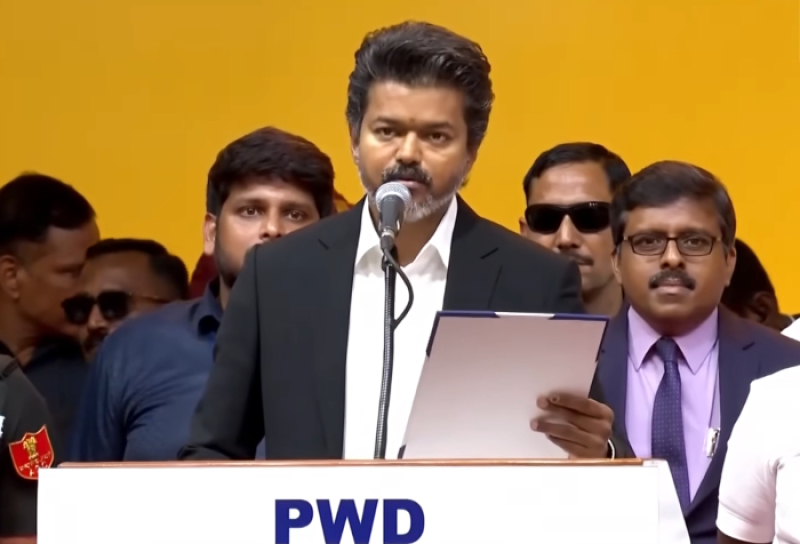
C. Joseph Vijay, an actor-turned-politician, has taken office as chief minister of Tamil Nadu, becoming the first Christian to lead the populous southern Indian state.
Vijay was sworn in Sunday following a decisive electoral victory by his newly established party, Tamilaga Vettri Kazhagam, also known as the Tamil Victory Party or TVK.
The party secured 108 out of 234 seats in the state assembly, later gaining additional backing from left-leaning parties, communist groups, and the Indian Union Muslim League.
The outcome marked a major political shift, ending nearly six decades of alternating governance by the region’s dominant parties, the Dravida Munnetra Kazhagam and the All India Anna Dravida Munnetra Kazhagam.
Widely known by the nickname “Thalapathy,” meaning commander, Vijay comes from a family rooted in the film industry and was raised in the Catholic faith, according to UCA News.
Reaction from Catholic leaders has been measured, with some highlighting both the historic nature of the moment and the need for caution in interpreting its implications.
Charles Anthonyswamy, editor of The New Leader, described the results as “genuinely historic,” while also noting, “His Catholic heritage does not automatically translate into a pro-Christian administration, and conflating the two would be premature," in comments to UCA News.
He added that the Bharatiya Janata Party raised questions about Vijay’s religious background during the campaign, which may have influenced voting patterns among minority communities.
Despite such attention, Vijay’s campaign did not center on religion, instead focusing on social welfare policies and outreach to diverse religious groups through visits to various places of worship.
John Dayal, a senior journalist and spokesperson for the All India Catholic Union, noted that Vijay is not the first Catholic chief minister in India, citing examples from northeastern states.
“While we celebrate his identity, we should also hope he fulfills his promises and meets public expectations,” Dayal was quoted as saying by UCA News.
Among the policy positions associated with Vijay’s party is support for extending “Scheduled Caste” status to Dalit Christians who converted from Hinduism, a move that would grant access to affirmative action benefits such as reserved positions in education and government employment.
Currently, such legal recognition applies only to Hindus, Sikhs, and Buddhists from historically disadvantaged castes.
Concerns about religious freedom in India have also drawn international attention in recent years. Data compiled by the United Christian Forum indicates a steady rise in reported incidents of violence against Christians, increasing from 486 cases in 2021 to nearly 900 in 2025.
In a March report, the U.S. Commission on International Religious Freedom recommended that the State Department designate India as a “country of particular concern,” citing ongoing and systemic violations.