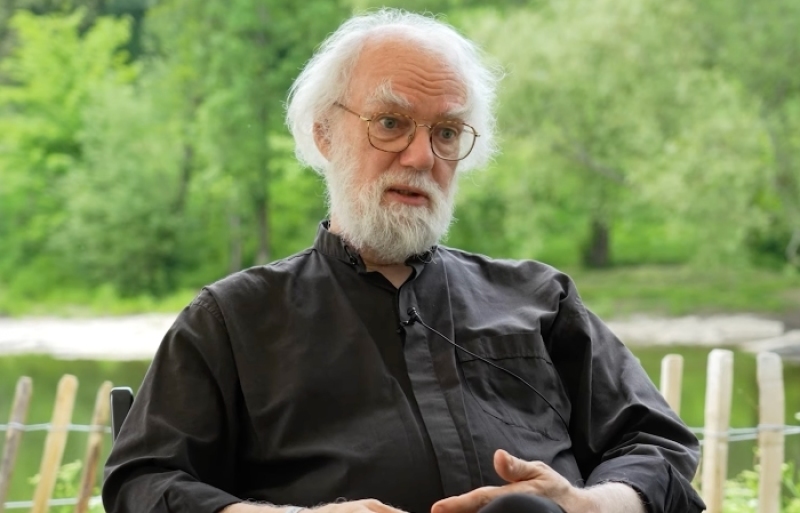
Former Archbishop of Canterbury Rowan Williams has raised doubts about the long-term future of the Anglican Communion, suggesting it may struggle to endure amid deepening internal divisions.
In a recent interview with Clerical Whispers published last week, Williams openly questioned the Communion’s survival.
"I don't know whether the [Anglican] Communion will survive," Williams said.
Williams, who led the Church of England from 2002 to 2012, made the remarks as his latest book, Solidarity: The Work of Recognition, is set for release this week.
He also revealed that he would not attend the installation of Archbishop Sarah Mullally, who is scheduled to become the 106th archbishop of Canterbury on March 25 at Canterbury Cathedral after completing an 87-mile pilgrimage from London.
Explaining his decision, Williams said, "You don't want to be Marley's ghost," referring to his reluctance to overshadow his successor. Mullally’s installation follows her formal confirmation at St. Paul’s Cathedral in London last month, where a protester, the Rev. Paul Williamson, was ejected from the service for shouting his objection to her confirmation.
Reflecting on his own tenure, Williams described the role of archbishop as demanding and often difficult, noting it was "no walk in the park" and that he frequently questioned whether it was "worthwhile."
He warned that Mullally is likely to face many of the same contentious issues that defined his leadership, particularly debates over women’s ordination and what he referred to as "the same-sex question."
While Williams acknowledged that tensions over women’s ordination have somewhat eased in England, he said disputes over gender and sexuality continue to divide the global Anglican Communion. Mullally has publicly supported both the ordination of women and the blessing of same-sex relationships.
Recent developments within the Church of England underscore those tensions. Last month, the General Synod voted to abandon plans for standalone blessing services for same-sex couples following prolonged debate.
Williams suggested that these theological disputes reflect broader societal challenges, including rapid social change, environmental concerns and a growing sense of instability.
He attributed the divisions in part to "the pace of social change, the environmental crisis, a sense of a loss of control on lots of people's parts — of decisions being made elsewhere."
"And particularly that sense of powerlessness — 'I do not know where the levers are that will give me some control.'"
Mullally’s appointment has also drawn criticism from conservative Anglican groups. Following the announcement last October, leaders within the Global Anglican Futures Conference (GAFCON) rejected her authority as a spiritual leader.
GAFCON, which was established in 2008 in Jerusalem, recently held the first official gathering of the Global Anglican Communion in Abuja, Nigeria. Although there had been speculation that the group might appoint a rival figure to the archbishop of Canterbury, it ultimately chose not to do so.