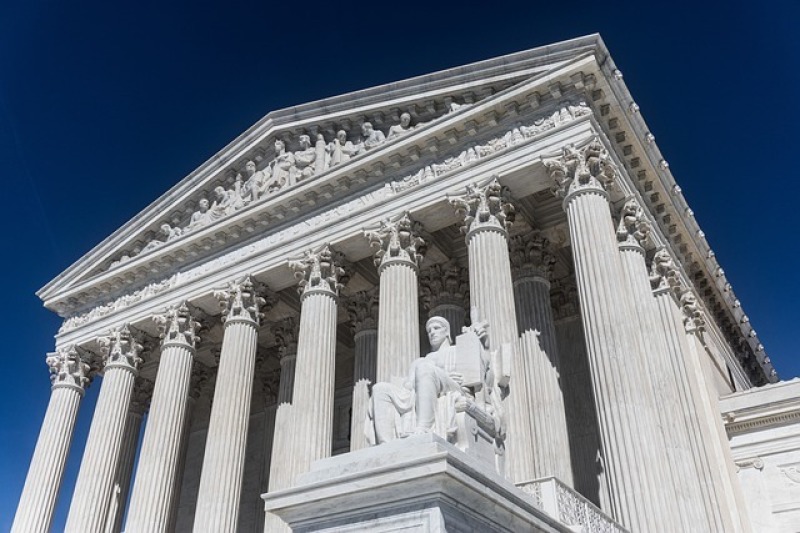
The U.S. Supreme Court has invalidated a Colorado law that prohibited licensed counselors from providing therapy to minors seeking to change their sexual orientation or address gender dysphoria in a way that affirms their biological sex.
In an 8-1 ruling issued Tuesday in Chiles v. Salazar, the justices determined that the state’s law improperly restricted the speech rights of Christian therapist Kaley Chiles.
Justice Neil Gorsuch authored the majority opinion, stating that “we conclude that the courts below failed to apply sufficiently rigorous First Amendment scrutiny in this case.”
“While the First Amendment protects many and varied forms of expression, the spoken word is perhaps the quintessential form of protected speech. And that is exactly the kind of expression in which Ms. Chiles seeks to engage,” Gorsuch wrote.
“Colorado’s law does not just regulate the content of Ms. Chiles’s speech. It goes a step further, prescribing what views she may and may not express.”
Gorsuch further emphasized that “the First Amendment stands as a shield against any effort to enforce orthodoxy in thought or speech in this country” and that “any law that suppresses speech based on viewpoint represents an ‘egregious’ assault on both of those commitments.”
The ruling overturns a prior decision by the U.S. Court of Appeals for the Tenth Circuit and returns the case to lower courts for additional proceedings.
Justice Elena Kagan filed a concurring opinion joined by Justice Sonia Sotomayor, noting that if Colorado had adopted "a viewpoint-neutral law, it would raise a different and more difficult question.”
“Once again, because the State has suppressed one side of a debate, while aiding the other, the constitutional issue is straightforward,” she wrote. “We need not here decide how to assess viewpoint-neutral laws regulating health providers’ expression because, as the Court holds, Colorado’s is not one.”
Justice Ketanji Brown Jackson issued the lone dissent, arguing that Chiles’ role as a licensed medical professional limits the scope of her First Amendment protections.
“Chiles is not speaking in the ether; she is providing therapy to minors as a licensed healthcare professional,” Jackson wrote. “Under our precedents, bedrock First Amendment principles have far less salience when the speakers are medical professionals and their treatment-related speech is being restricted incidentally to the State’s regulation of the provision of medical care.”
Jackson maintained that the state was justified in restricting the therapy, citing opposition from major medical organizations.
The Colorado law at issue, enacted in 2019, prohibited what it described as “conversion therapy” for minors after similar proposals had previously failed to pass in earlier legislative sessions.
Chiles filed her legal challenge in September 2022, arguing that the law violated both the Free Speech and Free Exercise clauses of the First Amendment.
In September 2024, a divided three-judge panel of the U.S. Court of Appeals for the Tenth Circuit upheld the state law in a 2-1 decision, affirming an earlier district court ruling.
The Supreme Court heard oral arguments in the case last October, with attorney James Campbell of Alliance Defending Freedom representing Chiles.