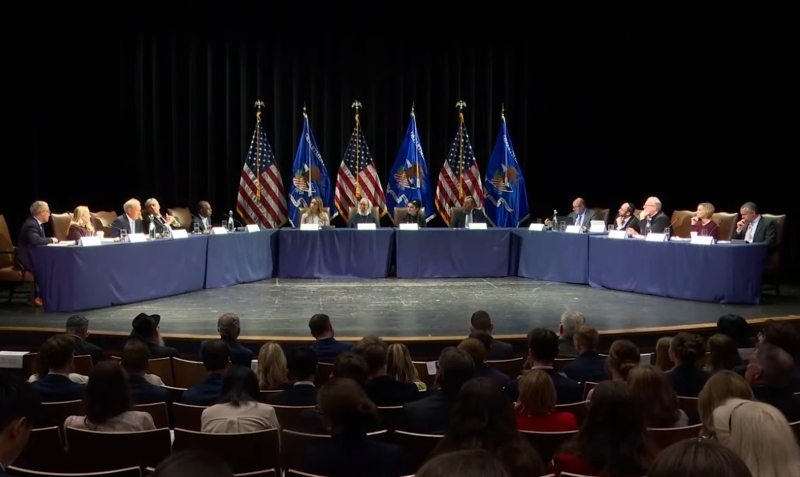
The seventh session of the White House Religious Liberty Commission took place Monday at the Museum of the Bible, where participants examined the historical roots, current challenges and future direction of religious freedom in the United States.
Led by Dan Patrick, the commission’s final hearing featured multiple panels addressing the development of religious liberty in America as well as ongoing debates over the legal concept of church-state separation.
Patrick pushed back on that concept, stating, “It is time to set the record straight: there is no such thing as 'separation of church and state' in the Constitution,” adding, “For too long, the anti-God Left has used this phrase to suppress people of religion in our country.”
Helen M. Alvaré of George Mason University Antonin Scalia Law School opened the proceedings by describing religious liberty as an "objective good" and argued that government overreach presents a greater concern than conflicts between different faith groups.
Among those offering testimony was Sister Mary Elizabeth, SV, who outlined the legal challenges faced by the Sisters of Life in New York, saying the state "passed a law targeting our ministry to pregnant women."
She explained, “It allowed government officials to force pregnancy centers, but only those that do not perform abortion, to turn over internal documents, including sensitive information about the women we serve.”
Robert Barron, who leads the Diocese of Winona-Rochester, said the primary spiritual battle in the United States is between traditional religious faith and a prevailing culture of moral relativism, which he suggested ultimately amounts to self-worship.
He cautioned that this worldview has gained influence and that its advocates "want religion out of the pivotal institutions of our society."
Barron also pointed to the growing number of Americans with no religious affiliation, expressing concern that declining biblical literacy could have political consequences in a nation historically shaped by Christian ideas.
Christian author and commentator Eric Metaxas highlighted the historical foundations of religious freedom, emphasizing how central biblical beliefs were to the formation of the United States.
Drawing from his forthcoming book on the American Revolution, he said the principle that individuals are endowed with rights by a Creator is "fundamentally a biblical idea."
“So at the heart of America, at the heart of American liberty and religious liberty, is faith in the God of the Bible. And I think part of the reason we're in this mess is because that used to be assumed, but secularists in the last 100 years or so have undermined this,” he said.
“These things cannot be wiped away, but we've forgotten them. So I would say the more Christian faith we have in our culture, the more liberty we have,” he added.
Following Metaxas’ remarks, Patrick noted that respect for different religions was part of discussions he and Donald Trump had when establishing the commission, while also identifying secularism as a shared challenge.
“And it's interesting, the secular movement attacks all of us. They don't just attack the Christians, they don't just attack the Jews, they don't just attack the Hindus. They go after everyone,” he said.
The commission is expected to conclude its work next month by submitting a report to the president, although Patrick echoed Barron’s view that its mission should continue beyond that point.